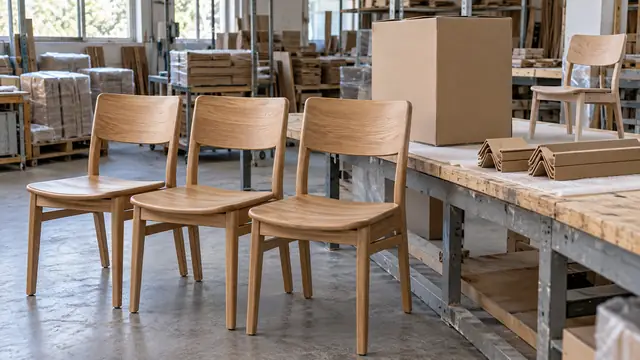
A proprietary furniture brand begins long before the logo on the box. A store or a new brand needs to understand who and how will manufacture the product, whether they can replicate it in several months, and what will happen if a defect occurs. These questions are especially important for the first batch, when there is no experience in collaborative work with the factory.
Choose a clear partnership model
There are several scenarios for contract manufacturing. You can order a ready-made factory model with your own branding. You can modify an existing design: choose different decor, dimensions, handles, or a hardware set. You can also submit your own project for development and manufacturing.
The first option usually requires less preparatory work. The latter offers more freedom but involves a separate stage of design and sample approval. Before requesting a quote, determine which of these options you need. Otherwise, one factory will calculate the finished product, while another will include the development of a new model.
Describe the product so that quotes can be compared
A single image from a selection is not enough. For an initial calculation, provide dimensions, the purpose of the furniture, desired materials, quantity of items, and the delivery location. If drawings are available, specify their version. If there are no drawings, state explicitly that development is required.
The initial specification may be incomplete. Note which parameters are mandatory and where the manufacturer can suggest their own option. For example, the external dimensions and decor are fixed, while the design of the back wall can be discussed. This helps the factory provide a meaningful response without guessing the customer's priorities.
- Model name and product purpose.
- Dimensions, layout, or drawings with the version date.
- Materials, finishes, and preferred hardware.
- Planned volume of the first batch and estimated order frequency.
- Assembly, packaging, and labeling requirements.
- Delivery address and desired completion date.
Discuss minimum order quantities alongside the product range
The minimum order can be calculated by model, decor, total cost, or total volume. These options yield different results. An order for fifty items of one configuration and fifty items in ten different decors are different tasks for material procurement and production setup.
Therefore, clarify not only the quantity of units but also the rules for combining positions. Find out if it is possible to mix colors within a batch, how many hardware options are permitted, and how this affects the lead time. If demand is not yet known, discuss a small pilot order with a limited number of variations.
Do not base your calculations solely on the price of a large batch if you intend to start with a small volume. Request a quote specifically for the order you are ready to place, and separately—the terms for increasing the volume after sales are verified.
Use a sample to agree on the details
For a new or modified model, produce a sample before serial production begins. Its purpose is to verify the appearance, construction, assembly, and packaging. The item should be assembled, inspected from various angles, and the movement of doors or drawers should be checked. If necessary, test its performance under the agreed load.
Submit comments point by point with photos: "change handle position," "replace guide SKU," "add corner protection for packaging." The phrasing "make it higher quality" does not provide production with a measurable task.
After corrections, fix the approved configuration. If a sample is approved only visually, it does not imply automatic consent for any hidden fasteners and materials. The specification and the sample must describe the exact same version.
Labelling and packaging affect sales
The factory needs to know in advance how the product will reach the customer: through your store, a dealer's warehouse, delivery of a finished product, or shipping in a disassembled state. This determines the packaging, kitting, and assembly instructions.
Discuss the placement of the brand name, model SKU, order number, and packaging location labels. If a product consists of several boxes, their connection must be clear to the warehouse staff. Fasteners should be packed and labeled so that the buyer can easily verify the completeness of the set.
Provide the sales channel's requirements for labeling, barcodes, and packaging in a separate document. Do not assume the manufacturer is familiar with the specific rules of your platform. Use the pilot batch to verify the ease of receiving, storing, and shipping the goods.
Agree when the production lead time begins
The shipping date depends on project approval, payment, availability of the panel, finish, and hardware. Clarify from which event the promised lead time begins. If materials are ordered separately, request that the procurement of components and the production of the batch be separated.
A clear procedure for material substitution is required. The factory may offer a similar decor or different hardware, but for the brand, this constitutes a product change. Substitution must be approved before production, especially if photos and descriptions of the model are already live in the store.
Agree on acceptance criteria before shipping
Determine who accepts the batch, where the inspection takes place, and which characteristics are evaluated. For appearance, clear requirements for visible surfaces are needed; for configuration, a list of parts and hardware is required; for geometry, approved dimensions and tolerances agreed upon with the manufacturer are necessary.
Agree separately on defect management: how to record a problem, who to send the information to, and in what form a replacement of a part or product is possible. If you sell furniture to an end consumer, it is useful to find out in advance if it is possible to promptly obtain a single facade, side panel, or a set of fasteners.
Plan repeat orders during the first production run
A successful start helps little if the next delivery differs in shade or hardware. Save material SKUs, drawing versions, sample photos, and agreed packaging requirements. The manufacturer must have a clear identifier for your specific configuration.
After the pilot batch, collect feedback from the warehouse, assemblers, and customers. Sometimes changing the box labeling is more beneficial than adding a new color to the assortment. Incorporate approved changes into the specification before reordering.
Where to find the right manufacturer
When ordering under your own private label, consider not only the assortment but also the factory's willingness to work with repeat orders, your custom packaging, and agreed-upon modifications. Start with furniture manufacturers for your own brand, then send the same brief to the selected companies.
If it is currently difficult to determine the appropriate technology or compile a list of factories, leave a manufacturer selection request. Specify the type of furniture, volume, and requirements for the first batch—this data is sufficient to begin a detailed discussion.