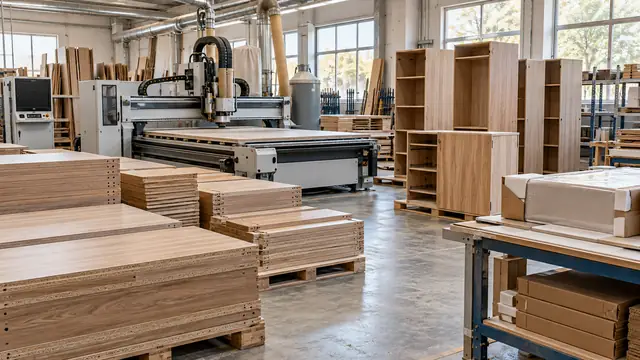
A cabinet in a catalog looks simple: a body, fronts, and a few shelves. In the workshop, a chain of operations stands behind this construction. A drawing error carries over to the cutting process, imprecise machining hinders assembly, and poor packaging ruins a finished product. Therefore, when choosing a manufacturer, it is more useful to discuss specific production stages rather than the number of machines in photos.
Start with the design and specification
The production of cabinet furniture begins with a project. The designer determines the dimensions of the parts, the joining method, the placement of shelves, and the hardware. For kitchens, additional considerations include appliances, utilities, and installation conditions. Images of the fronts help coordinate the appearance but do not replace working drawings.
The specification links the project to procurement and the workshop. It requires precise SKUs for boards, edging, hinges, and runners. An entry like "Laminated chipboard, oak color" leaves too many options: different suppliers offer different patterns, textures, and shades. If an order is repeated several months later, it is the SKU that helps reproduce the agreed-upon product.
Hardware is selected before production starts. Hinge geometry, required clearances, and guide mounting dimensions affect the construction. Hardware manufacturers provide selection tools and engineering data; for example, the Blum configurator helps select components and obtain data for planning. For a procurement specialist, the practical question is: which set is installed in the sample, and will it be maintained throughout the batch?
Cutting: dimensions and grain direction matter
At the cutting station, sheets are transformed into parts. The cutting map determines the placement of workpieces and helps utilize material efficiently. However, material optimization must not affect the appearance of the furniture: the orientation of the wood grain on adjacent facades and visible panels shall be coordinated separately.
A clean cut depends on the equipment, tools, and operation settings. Chips on the decorative coating cannot be assessed from a photo of the machine. Ask to see the finished part in a close-up or inspect the sample under side lighting. Damage near the edges is particularly noticeable on visible surfaces.
Parts are marked after cutting. For serial orders, the marking must link the blank to the model, the order, and the set. Otherwise, correctly manufactured panels may end up in the wrong packaging, and the problem will only be discovered by the customer.
Edge banding: edges need a clean finish
The edging covers the edge of the board. The technical specifications indicate which sides of the part are to be faced, with which material, and with what thickness. The phrasing "edging around the perimeter" is convenient only when both parties have the same understanding of its application to all parts of the product.
On a finished panel, the edge banding, glue joint, and corner treatment are inspected. There must be no visible peeling, protruding sharp edges, or surface damage. The color is checked against the board's decor: a similar shade name does not guarantee a perfect match.
For furniture near water sources, the protection of vulnerable areas—such as cutouts, joints, and sink installation points—is discussed. High-quality edging alone does not turn any board into a material suitable for constant contact with water. Application conditions are specified in the documentation for the selected material and the product's construction.
Drilling: holes must align during assembly
Machining refers to the creation of holes for joints and hardware. At this stage, not only the coordinates of the hole are checked, but also its depth, diameter, and distance to the edge. If a panel needs to be drilled during assembly, the cause may lie in the design or the processing software.
Automated equipment helps repeat operations; however, the result still depends on the initial data and monitoring. It is useful to find out how the factory checks the first part after a program change and what they do if a deviation is detected. For repeat orders, it is also important to know where the approved version of the drawings is stored.
Trial assembly before batch production
For a new model, it is reasonable to assemble a sample before serial production. The geometry of the cabinet, facade gaps, the operation of doors and drawers, and the completeness of the fasteners are checked. A drawer without contents and a drawer with the intended load may behave differently; testing conditions shall be agreed upon in advance.
The sample records what is difficult to describe in a single line: visible joints, shades, handle positioning, and the feel of the closing mechanism. Photographs are useful as a supplement to the specification. It is best to keep the sample itself if long-term work with the model is expected.
A defect in the first assembly is cheaper to fix than repeating it in dozens of sets. Therefore, the timelines for development, sample production, and batch release should be separated. The promise of "ready in two weeks" must have a clear starting point: project approval, receipt of materials, or payment.
Packaging is part of production
Case furniture is often shipped disassembled. In such cases, the packaging must protect surfaces and edges, prevent parts from shifting, and separate hardware from decorative panels. Different solutions may be required for a long component versus a small facade.
Check the location markings, the list of inclusions, and the assembly instructions. If a single product consists of multiple boxes, the buyer must be able to identify which boxes belong to the same set. For sales through a warehouse or marketplace, the specific platform requirements for dimensions and marking will be coordinated separately.
What to ask the factory before ordering
- Who is responsible for shop drawings and the approval of the first prototype?
- Which material and hardware SKUs are fixed in the specification?
- How is the first part verified after the cutting and drilling setup?
- Will there be a trial assembly, and who will approve the sample?
- How are kitting, labeling, and packaging organized?
- What happens if the material or hardware from the specification is unavailable?
Answers help compare offers on identical terms. First, determine which products and volumes are required, then view the furniture manufacturers in the catalog. It is more convenient to discuss technology using a specific model as an example, and cost based on the approved configuration.