In a commercial proposal, you may encounter two equally imprecise phrases: "MDF furniture" and "chipboard (LDSP) furniture." In reality, the carcass, facade, back panel, and countertop are often made from different materials. To select the correct configuration, you must first divide the product into these components.
How laminated particleboard and MDF differ
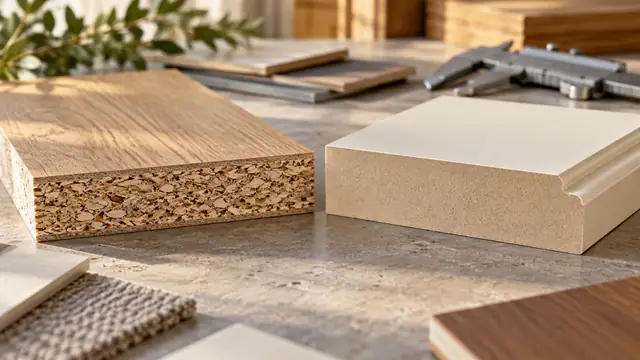
LDSP is a wood-chip board with a decorative laminated coating. In furniture manufacturing, it is frequently used for carcasses, shelves, partitions, and flat fronts. The factory coating provides the desired finish immediately, while the parts require edge processing and drilling for assembly after cutting.
MDF is a medium-density fiberboard. Its structure allows for surface milling: creating recesses, profiles, and patterns on the facade. The final appearance depends on the subsequent finish. This could be painting, film, veneer, or another coating provided by the specific technology.
Therefore, comparing "Laminated Chipboard vs. MDF" without specifying the finish is not very useful. To place an order, a complete set of specifications is required: board type, finish, edge treatment, part geometry, and usage conditions.
Cabinet construction should be practical
The cabinet body does not have to be made of the same material as the doors. A combination of an Laminated Chipboard (LDC) body and MDF facades is a common structural solution. It allows for the desired facade appearance without applying the same manufacturing technology to every internal partition.
The performance of the carcass is affected by the thickness of the parts, the span of the shelves, the method of attaching the back panel, and the joints. Replacing a material alone will not fix a shelf that is too long or an unsuitable mounting method. If heavy items are to be stored, the load should be discussed with a designer and verified on a sample.
A useful question for the factory: why was this specific thickness and construction chosen? The answer "we always do it this way" provides less information than a technical drawing and an explanation of the intended load.
Choose the appearance of fronts first
For a smooth facade with a wood grain finish, LDF (Laminated Decorative Fiberboard) may be a suitable option. If a milled pattern or profile is required on the surface, MDF is more commonly used. Note that different MDF coatings differ significantly in manufacturing technology and maintenance requirements.
For a painted facade, the color, gloss level, and surface quality are agreed upon. For a filmed facade, the decor, texture, and the behavior of the coating on complex areas are discussed. For a veneered facade, the grain direction and permissible natural variations are specified. The name of the material alone does not resolve these questions.
Check samples under the same lighting in which the furniture will be used. The shade on a screen and the actual facade may differ. For a batch, it is advisable to secure a physical approved sample of the finish, rather than just a photograph.
Pay particular attention to edges and joints
In panel furniture, the edge is an independent processing area. ABS edging is used to finish the narrow sides of faced wood panels, including chipboard and MDF; this option is described in EGGER materials. However, the edging material alone does not reveal everything about the quality of the joint with the panel.
Specifications fix the thickness and color of the edging, the list of surfaces to be clad, and requirements for visible corners. On the sample, the fit and appearance of the joint are checked. The statement "the edging is expensive" is not a substitute for inspecting the finished part.
Cutouts, countertop joints, and areas near the sink are considered separately. EGGER's recommendations for countertop care emphasize the timely removal of spilled liquids, especially near cutouts and joints. Practical conclusion for ordering: the protection of these areas must be discussed alongside the construction and installation.
Check moisture resistance for the specific product
The term "moisture-resistant" in a board's name does not mean that finished furniture can be kept in water constantly. The final result depends on the board itself, the coating, exposed edges, and the quality of installation. A kitchen cabinet near a sink and a cabinet in a dry bedroom operate under different conditions.
Do not assign a material for a wet zone based on a single marketing phrase. Request documentation for the selected board and recommendations for its application. The factory must understand where the product will be placed and which areas may come into contact with moisture.
Why panel names alone are insufficient for comparing prices
Cost is influenced by the supplier and material decor, the number of parts, cutting, edge processing, milling, and finishing. A painted facade of a complex shape and a smooth rectangular facade involve different sets of operations. A single general price tag "for MDF furniture" hides this distinction.
To make the comparison useful, send the same task to all manufacturers. Ask them to specify the cost of the product in the base configuration and the price for a specific substitution: a different decor, facade, or hardware. This will clarify exactly what change you are paying for.
How to specify materials in a production brief
- Body: board manufacturer, decor SKU, texture, and thickness.
- Fronts: base material, geometry, coating type, and approved color sample.
- Edges: edging material, its thickness, and the sides of the parts that need to be processed.
- Countertop and cutouts: material, joint construction, and the method of protecting vulnerable areas.
- Substitutions: the procedure for approval if the required material is not in stock.
If a choice has not been made yet, ask the factory to offer two options for a single construction and explain the differences. You can start your search in the furniture manufacturers catalog. Compare ready-made solutions with identical dimensions and hardware: this makes the difference between materials clearer.